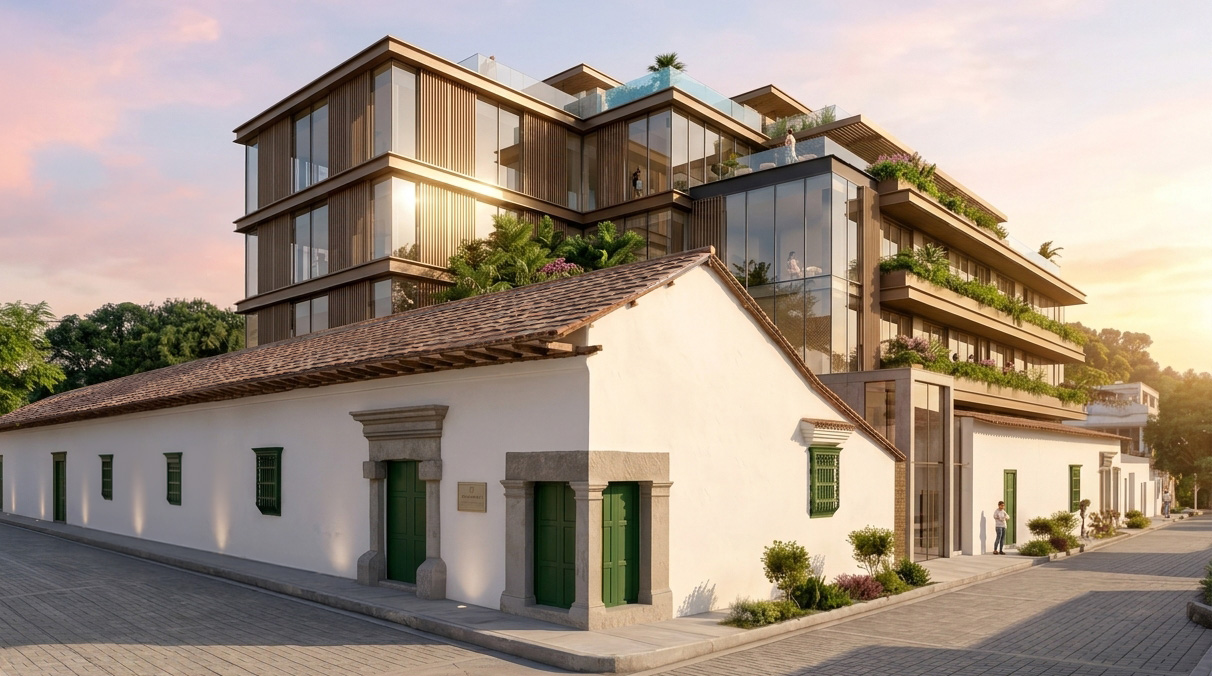
San Sebastián de Mariquita is emerging as one of northern Tolima's most compelling growth stories. Positioned on the strategic corridor between Bogotá and Medellín at 20 minutes from Honda, with direct access to the Coffee Region, a stable year-round climate averaging 26 °C, and a deep colonial heritage tied to the Royal Botanical Expedition, the municipality offers the kind of fundamentals that attract serious real estate capital [Tolima Gov]. Residential price per square meter remains well below national averages at 4 to 6 million COP/m² [DANE IPVN], creating a clear window for projects that capture significant appreciation as infrastructure and tourism converge [Tinsa Research].
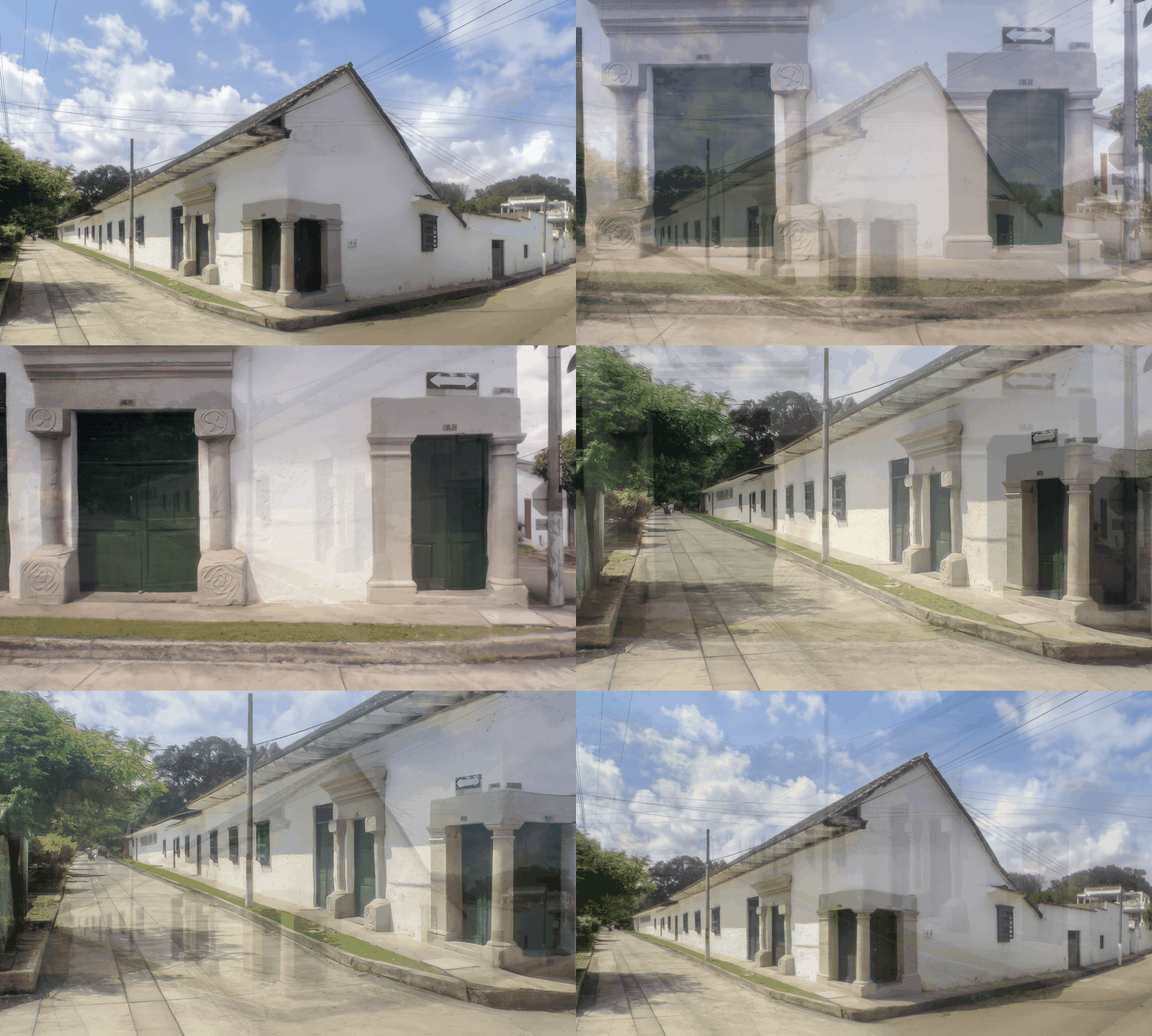
Casa del Virrey enters the market not as a finished product but as something far more valuable: a full 6,038 m² urban block anchored by a corner colonial casona designated as a Cultural Interest Asset (BIC). The opportunity is to reimagine the entire block as a mixed-use heritage development where contemporary architecture dialogues with a restored historic "brand house." The value equation combines scale, location, and heritage identity into a single development platform capable of supporting residential, healthcare, educational, wellness, commercial, or hospitality programs, individually or in combination.
Why is this report critical for an investor or developer?
- Empirically Verified Value Creation in Colombia (White Papers): Independent audits demonstrate that heritage assets deliver substantial ADR and valuation premiums: Sofitel Legend Santa Clara was appraised by JLL at US$ 48.4M (~US$ 390,000 per key); La Serrezuela created a COP $330,000M commercial asset following COP $200,000M in works; and Casa Pestagua commanded over US$ 15M in institutional reinvestment under Relais & Châteaux.
- Macro-Infrastructure Catalyst (COP $1.14 Trillion 4G Highway): The completed 256 km Cambao-Manizales corridor connects Mariquita minutes from the Coffee Axis and directly between Bogotá and Medellín, capturing high-yield corporate, logistics, and leisure travel.
- Full City Block Scale (6,038 m²) for Diversified Uses: Enables diversified cash flows by combining mid-rise residences, senior living or long-stay suites, health & wellness facilities, and retail dining promenades around the colonial manor as a heritage cultural anchor.
- Dual Fiscal Shield & Cash Rebate: Immediate cash monetization of 35% to 42% of CAPEX through tradable CoCrea CID tax certificates (165% deduction) plus a 100% income tax deduction on conservation expenditures over 5 years (Law 1185/2008).
- Favorable Entry Valuation with High Capital Gains Upside: With urban land prices between 4 and 6 million COP/m² versus 12–25 million in saturated colonial markets like Cartagena or Villa de Leyva, Mariquita provides an ideal strategic entry point.
Market Study Table of Contents
1. Mariquita as a Regional Growth Node
Mariquita occupies a strategic position in northern Tolima where two major corridors converge. The Bogotá–Villeta–Honda highway feeds into the route that continues northwest through Mariquita toward Manizales and the Coffee Region, while the town is also served by the José Celestino Mutis airport and sits at the heart of a fruit-growing and tourism circuit that includes Honda and Guaduas [Wikipedia]. The municipality has been recognized as Colombia's fruit capital and as a reference point for cultural and nature tourism [Tolima Gov].
The regional market confirms the thesis. Honda lists colonial and country houses averaging around 619 million COP, with built areas of ~358 m² and lots of ~617 m² [FincaRaíz Honda], while Guaduas shows colonial houses in its historic center at around 380 million COP for ~100 m² properties [FazWaz Guaduas]. The pattern is unmistakable: warm-climate historic towns within reach of Bogotá command premium per-square-meter values when they successfully blend heritage, tourism, and contemporary projects. Mariquita, with its infrastructure catalysts and untapped urban block supply, is positioned to match or surpass these benchmarks.
2. Real Estate Asset Types in Mariquita & Price Ranges
Understanding the local pricing landscape is essential before positioning an asset of Casa del Virrey's caliber. The data below draws from active listings across the region's major portals to establish a clear picture of where the market stands today.
Standard Residential Housing
- Urban houses with 2–4 bedrooms in consolidated residential neighborhoods.
- Typical areas: 54–150 m².
- Price ranges: approximately 165–400 million COP (~2.2–4.0 million COP/m²) according to [Ciencuadras] and [FincaRaíz Mariquita].
- Primary use: family housing, with no explicit tourism or heritage component.
Central Houses & Urban Quintas
- Single-family central houses of ~250–300 m² are listed around 550–650 million COP (~1.8–2.6 million COP/m²).
- Quinta houses with gardens and pool in "Mariquita's best neighborhoods" appear in ranges of 670–1,050 million COP (~1.3–3.5 million COP/m²).
- Mixed use: weekend retreat, residence, possibility of short-term rental.
House-Lots & Mixed/Commercial Projects
- "House-lot for commercial project" and "profitable" corner houses on central corridors.
- Lot/construction areas between 294 and 838 m².
- Price ranges: approximately 530–920 million COP (~0.6–3.1 million COP/m²).
- Main value: partial demolition potential and conversion to retail, hotel, apartments, or mixed-use projects.
Urban Tourist Houses & Operating Quintas
- Example: urban tourist house of 440 m² with 8 bedrooms, 9 bathrooms and pool, listed at 750 million COP (~1.7 million COP/m²), oriented to tourism/Airbnb use.
- Tourist quintas with multiple pools, jacuzzis and recreational areas, with areas of 400–480 m², range between $900 million and $1,800 million COP (~US$ 225,000–$450,000), depending on size and finishes.
- The price reflects both the property and the ongoing tourism operation and current level of maintenance.
Colonial Houses in the Historic Core
- Restored colonial houses in historic neighborhoods such as La Ermita, within Mariquita's old town.
- Example: restored corner colonial house with pool, meeting room, porch, gardens and parking, listed at 1,400 million COP (~2.3–3.5 million COP/m²).
- These are important comparables for Casa del Virrey, but with lots and built areas clearly smaller than a full urban block, and they are offered as finished product, not as development land.
Rural Lots & Peri-urban Land
- Urban lots of ~485 m² with small construction for about 120 million COP.
- Farm project in the El Caucho vereda ("Golden Rectangle") subdivided into 7 lots of 5,000 m², each valued at 300 million COP, with water and power, productive and country-house vocation.
- Approximate rural/peri-urban land ranges: 60,000–250,000 COP/m², depending on services, landscape, and proximity to the urban core.
Price Segments Summary Table
| Segment | Use Type | Price Range (COP) | Approx. Price / m² | Scope & Examples |
|---|---|---|---|---|
| Standard urban residential | Family housing | 165–400 million | ~2.2–4.0 million/m² | 2–4 bed houses, 54–150 m², residential neighborhoods. |
| Central house / urban quinta | Residential + retreat | 550–1,050 million | ~1.3–3.5 million/m² | Central houses 250–300 m²; quinta houses with pool. |
| House-lot & mixed projects | Commercial + housing + rental | 530–920 million | ~0.6–3.1 million/m² | Central house-lots 294–838 m², commercial projects. |
| Urban tourist house | Tourism, Airbnb, short-stay rental | ~750 million | ~1.7 million/m² | 440 m² house, 8 bed, 9 bath, pool. |
| Colonial house in historic core | Heritage, tourism, cultural | ~1,400 million | ~2.3–3.5 million/m² | Restored colonial house, La Ermita neighborhood. |
| Rural / peri-urban lots | Country, agro, country houses | 120–300 million / lot | 60K–250K / m² | 485 m² urban lot; 5,000 m² lots in El Caucho vereda. |
Charts for This Page
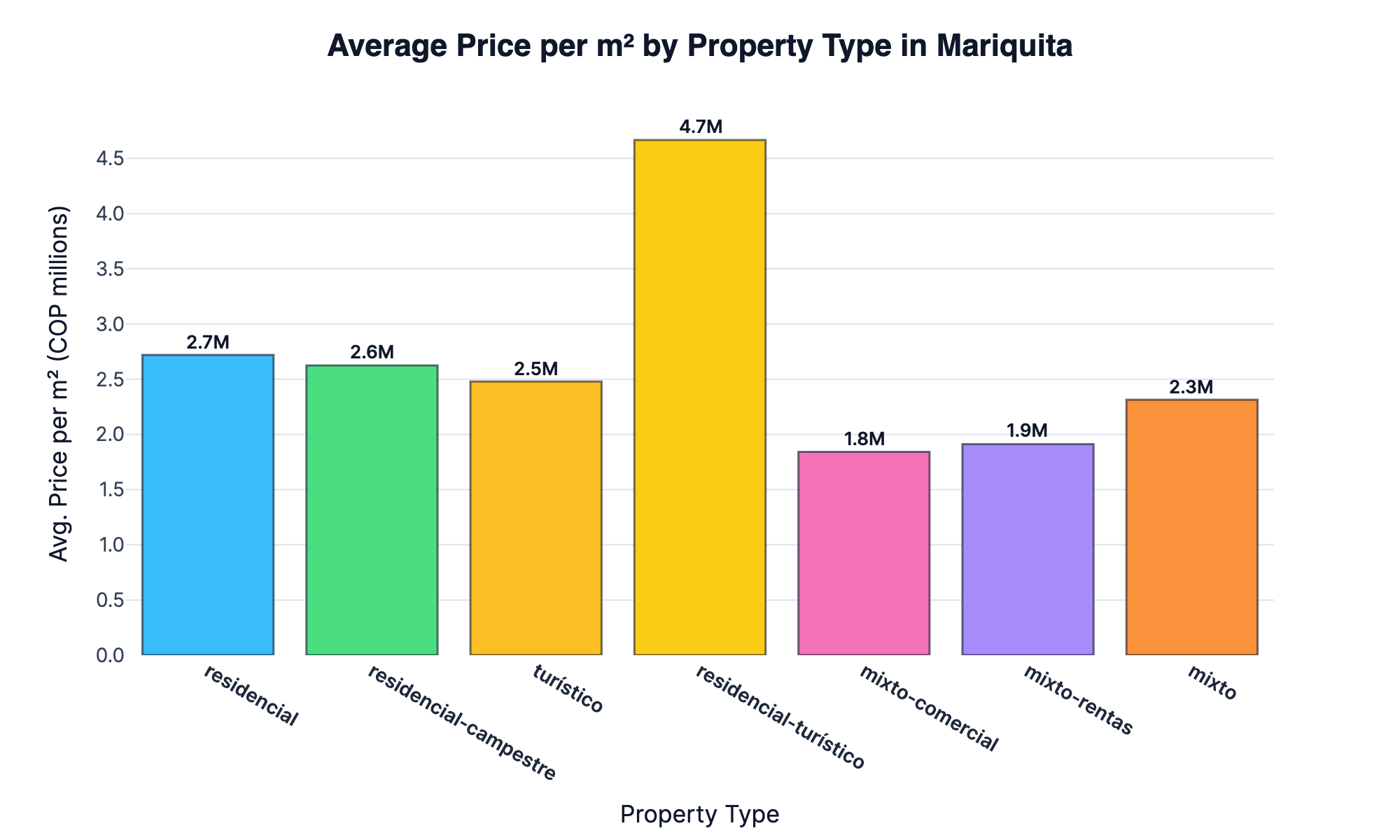
Average price per m² by property type. The bar chart below compares the average price per m² by property type (residential, tourist, mixed, commercial) in Mariquita, using the comparable sample. It helps the reader quickly visualize which segments pay more per square meter and where colonial and tourist houses sit relative to standard products.
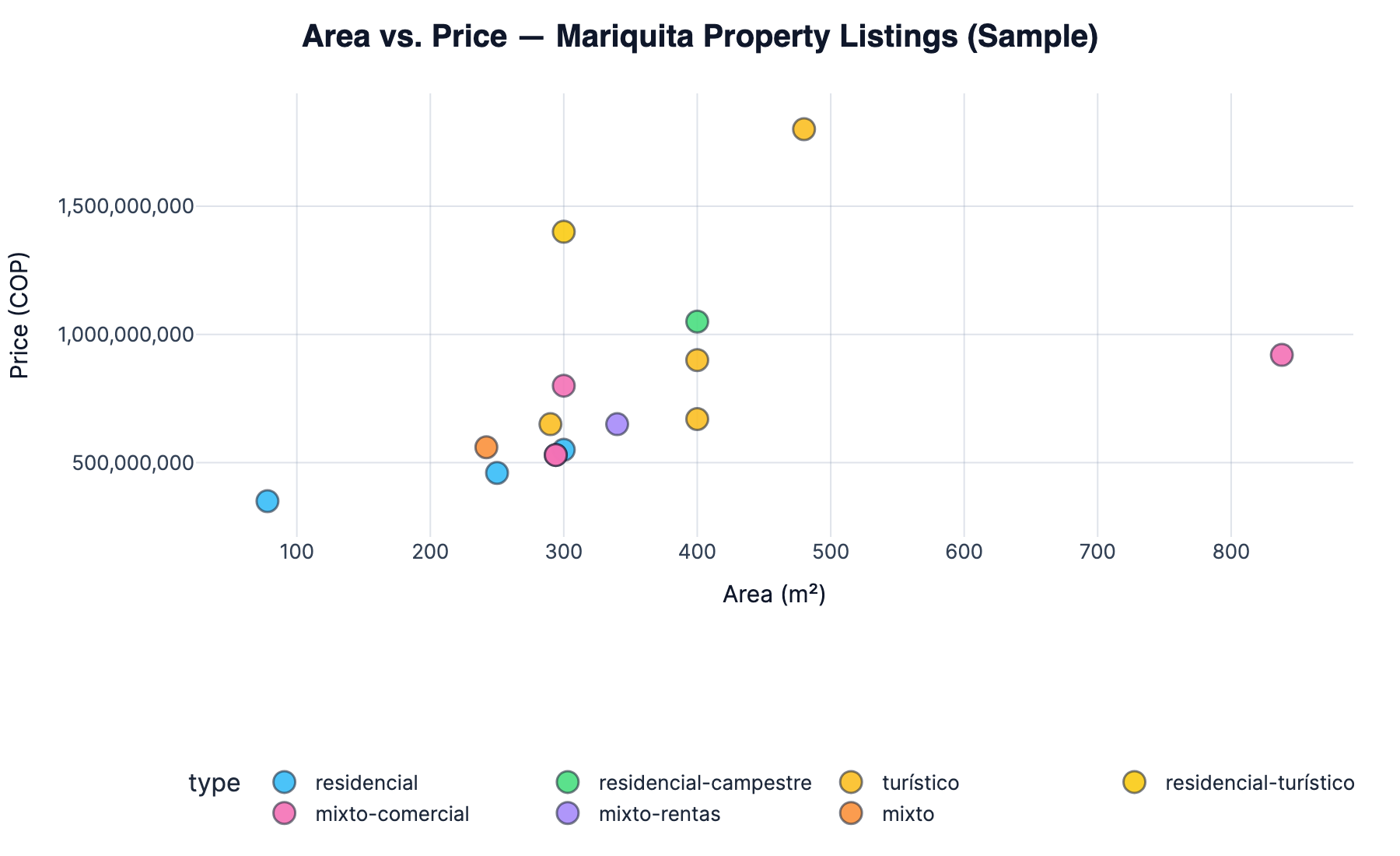
Area vs. price relationship. The scatter plot below maps area against price for Mariquita properties, demonstrating how price scales with size and use type. Projects that combine larger footprints, prime locations, and tourist or heritage programming concentrate at the top of the price spectrum, establishing the target value corridor for a finished development on Casa del Virrey's block.
Price per m² Summary by Property Type
| Property Type | Number of Listings | Average Price (COP) | Average Area (m²) | Avg. Price per m² (COP/m²) |
|---|---|---|---|---|
| Mixed use | 1 | 560,000,000 | 242 | 2,314,050 |
| Mixed commercial | 4 | 695,000,000 | 432 | 1,842,490 |
| Mixed income / rental | 1 | 650,000,000 | 340 | 1,911,765 |
| Standard residential | 3 | 453,333,333 | 209 | 2,720,171 |
| Country / quinta residential | 1 | 1,050,000,000 | 400 | 2,625,000 |
| Heritage residential / tourist | 1 | 1,400,000,000 | 300 | 4,666,667 |
| Tourist / Airbnb | 4 | 1,005,000,000 | 393 | 2,479,095 |
Data Sources: Local Mariquita market sample compiled from [FincaRaíz Mariquita] and [Ciencuadras], complemented by regional benchmarks from [FincaRaíz Honda] and [FazWaz Guaduas]. Date of inquiry: August and September 2026. Data type: referential market listings. Indicative calculations based on active market supply; does not constitute an official appraisal.
CASA DEL VIRREY
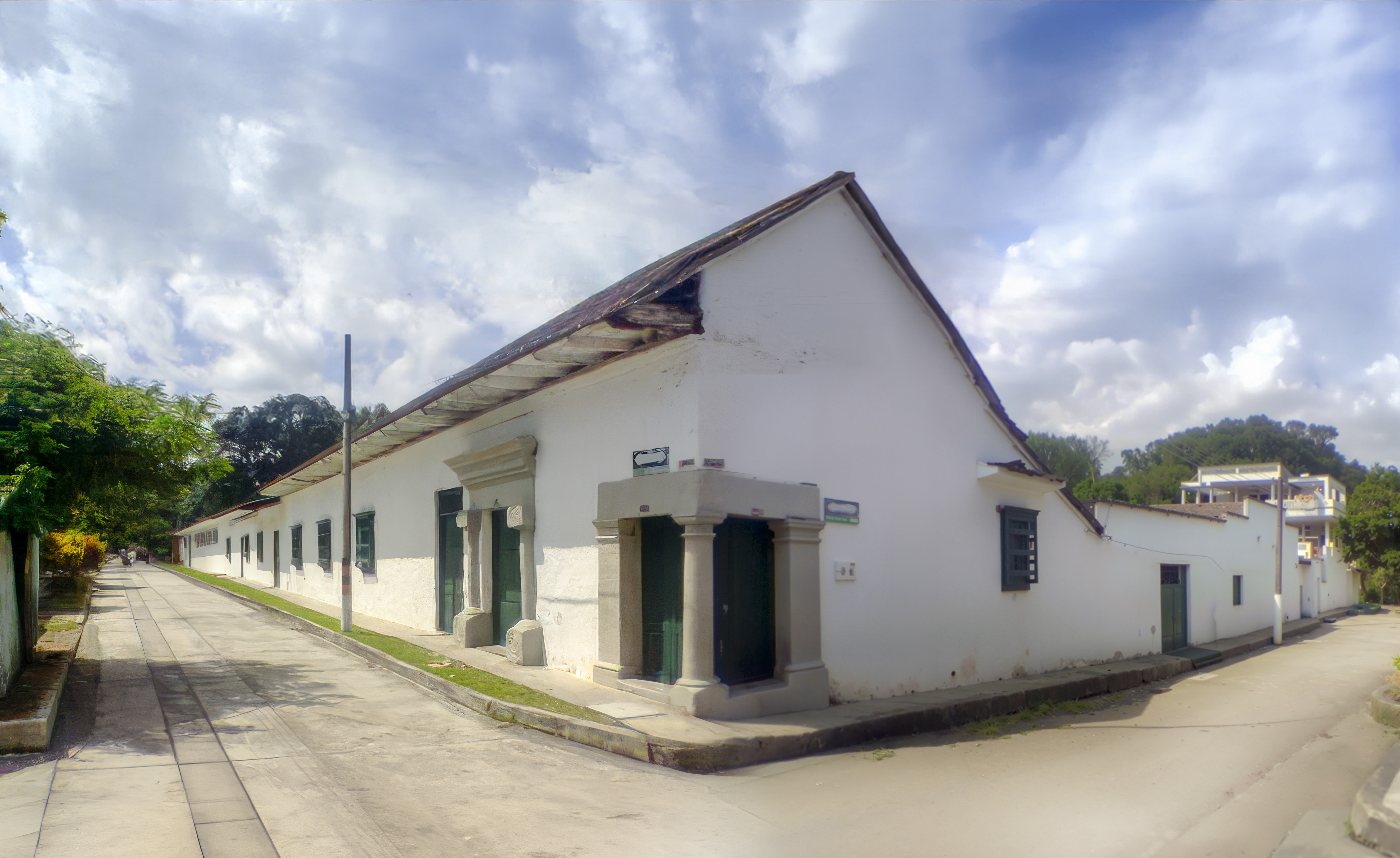
An exceptional 6,038 m² full city block in Mariquita. Corner colonial BIC casona plus expansive development land, ideal for a mixed-use project: boutique hotel, residential, healthcare, education, or wellness campus.
3. 4G Cambao-Manizales Highway (COP $1,144,000 Million / ~US$ 275M): Connectivity Impact
The single most impactful economic catalyst for land appreciation in northern Tolima this decade is the Cambao - Armero - Mariquita - Manizales 4G Highway Concession, executed under the supervision of the National Infrastructure Agency (ANI) and the Ministry of Transport [ANI Colombia].
With a total capital budget exceeding COP $1,144,000 million (thousands of millions of pesos, equivalent to ~US$ 275 million at the official TRM exchange rate of 4,160 COP/USD as of September 2024) and syndicated project financing of COP $458,000 million (~US$ 110 million) by Bancolombia and CAF Ashmore [ANI Project Dossier], this 256 km trans-Andean corridor directly connects Bogotá and the Magdalena River Valley to the Coffee Triangle (Manizales, Caldas) through northern Tolima [MinTransporte].
| 4G Highway Indicator | Official Figure / Source | Direct Economic Impact on Mariquita |
|---|---|---|
| Total Corridor Capital Investment | COP $1,144,000 million (~US$ 275M at official TRM of 4,160 COP/USD, Sep 2024) [ANI Colombia] | Massive regional capital injection driving rapid, sustained land value appreciation. |
| Syndicated Financial Backing | COP $458,000 million (~US$ 110M at TRM of 4,160 COP/USD, Sep 2024) [Bancolombia & CAF Ashmore] | Guaranteed financial closure securing the execution of the 256 km trans-Andean corridor. |
| Tolima Arterial Connection (146 km) | COP $225,361 million (~US$ 54M at TRM Sep 2024 for initial flatland rehabilitation, 100% operational) [MinTransporte] | Upgraded arterial connectivity directly linking Ibagué, Armero, Mariquita, and Honda. |
| Travel Time Savings | -1 hour on Cambao-Manizales route | Positions Mariquita as the primary hospitality and residential stopover toward the Coffee Region. |
| Construction Job Creation | +1,750 direct jobs during construction (ANI Balance March 2022) and thousands of indirect jobs. | Boosts local purchasing power and demand for commercial and hospitality services. |
4. Strategic Connectivity Matrix: Travel Times & Logistical Nodes
Mariquita’s central geographic placement establishes it as the natural junction between Colombia's main economic urban centers:
| Origin / Destination | Distance (KM) | Estimated Time | Highway Corridor & Economic Profile |
|---|---|---|---|
| Honda (Tolima) | 19 KM | ~20 min | National Route 50 / Route 45. Direct commercial neighbor, major Magdalena River port, and heritage tourism circuit. |
| Manizales (Caldas) | 118 KM | ~3 h 30 min | National Route 50 (via Fresno – Páramo de Letras) and connection to the new 4G Cambao - Manizales corridor. Gateway to the Coffee Axis. |
| Ibagué (Capital of Tolima) | 120 KM | ~2 h 15 min | Route 43 (Tolima Trunk Highway). Departmental capital, administrative seat, and commercial center. |
| Pereira (Risaralda) | 163 KM | ~3 h 40 min | National Route 50 + Coffee Highway (Autopista del Café). Economic, logistics, and airport core of the Coffee Triangle. |
| Bogotá D.C. (Capital District) | 166 KM | ~3 h 45 min | National Route 50 (via Honda – Guaduas – Villeta – Calle 80 / Portal 80). Primary feeder market for tourism and real estate investment (~185–195 KM to city center). |
| Armenia (Quindío) | 198 KM | ~4 h 15 min | National Route 50 + Coffee Highway. Commerce, rural tourism, and agro-industrial hub of western Colombia. |
| Medellín (Antioquia) | 284 KM | ~4 h 45 min | Magdalena Trunk Highway (Route 45) & Medellín-Bogotá Highway (Route 60). Colombia's second metropolis and industrial/tech powerhouse. |
Casa del Virrey: Urban Block & BIC Casona
Current State & Development Vision
Casa del Virrey consists of:
- A corner colonial casona, declared a Cultural Interest Asset (BIC), which contributes historic facade, brand identity, and symbolic value to the project.
- A full urban block of approximately 6,038 m², occupied by additions built in previous decades (a set of pools, complementary structures) that have now aged and that any serious developer will primarily consider as volume to demolish, reorganize, or replace.
Casa del Virrey is offered as a development site with a heritage anchor, not as a turnkey resort or operating quinta. What the buyer acquires is the raw canvas: a full urban block with a BIC casona on the corner, ready for a new ensemble of hospitality, housing, healthcare, education, wellness, or institutional uses built around the historic structure. The value proposition is the freedom to design, not the inheritance of someone else's operation.
Advantages of a Full Urban Block
The scale of a full urban block provides advantages that are hard to find in historic towns:
- Phased planning: successive stages can be executed (for example, first a central core of institutional or wellness use, then residential or hotel around it) without losing urban coherence.
- Multiple accesses and frontages: the block allows defining differentiated entrances for different programs (general public, patients, students, guests, residents), improving project operations.
- Interior streets and patios: an entry sequence can be generated where the BIC casona is the symbolic "gateway" and, once crossed, opens onto a world of plazas, patios, and new buildings, maintaining human scale and historic character.
Economic Role of the Corner BIC Casona
The corner BIC casona is not just a protected object:
- It acts as the project's brand: the ensemble can use the casona as institutional image, reception, lobby, historic library, cultural center, or administrative seat, reinforcing identity.
- It provides facade value: being on a corner, it gives the project immediate presence in the urban fabric and facilitates user recognition and orientation.
- It allows access to fiscal and heritage benefits specific to BIC assets, discussed in the economic section below.
6. Economic & Fiscal Benefits of a BIC (with explicit numbers)
Beyond preservation, Colombia's BIC legislation creates measurable financial advantages for developers who know how to structure them. The legal and technical framework is covered in full on the dedicated Historic Conservation Regulation in Colombia (BIC Regulation); what follows is the economic bottom line for the developer, with direct references to the relevant articles of Law 397 of 1997 and Law 1185 of 2008.
Income Tax Deductions (Law 397 & Law 1185)
FAQ: What is the PEMP?
PEMP stands for Plan Especial de Manejo y Protección, Colombia's Special Heritage Management and Protection Plan. It is the technical and legal document that Colombian law requires before any intervention (restoration, extension, partial demolition, change of use) can take place on a property designated as a Bien de Interés Cultural (BIC), a Cultural Interest Asset.
In plain terms: it is the "heritage masterplan" that the property owner must prepare, together with architects specialised in historic preservation, and submit to the Ministry of Culture (or the relevant territorial authority) to obtain official approval for whatever they plan to build, restore, or modify in the historic building.
The PEMP defines:
- Which parts of the building are untouchable (facades, original structures, courtyards, etc.)
- Which parts can be modified or demolished to make way for new architecture
- Which uses are permitted (hotel, residential, commercial, cultural, mixed-use, etc.)
- The technical specifications for materials, heights, and finishes compatible with the historic structure
Why it matters to investors: Mariquita's Historic Center has an approved PEMP under Resolution 0121, cataloging the casona as Level 2: Architectural Conservation (Decree 1080 of 2015, Art. 2.4.1.2.4), while expenses incurred in certified conservation works are 100% deductible from net taxable income (Law 1185 of 2008), alongside the statutory right to urban compensation for conservation burdens (Law 388 of 1997, Art. 48). Read the full PEMP guide →
Full deductibility of conservation and PEMP costs
- Article 56 of Law 397 of 1997, as modified by Article 14 of Law 1185 of 2008, states that owners of Cultural Interest Assets "may deduct the totality of the expenses" incurred in preparing Special Plans (PEP/PEMP) and in the maintenance and conservation of these assets, even when those expenses do not have a causal relationship with their income-producing activity.
- In practical terms, this is a 100% deduction of eligible PEMP and conservation expenses from the income tax base, for both individuals and legal entities, as long as the project is approved by the competent heritage authority (Ministry of Culture or territorial entity).
Quantified caps and time windows (Decree 1080 of 2015)
- PEMP preparation cap: Article 2.4.2.1(1) of Decree 1080 of 2015 specifies that the deductible expenses for hiring specialized services to formulate a PEMP are capped at 100 salarios mínimos legales mensuales (100 SMLM) per PEMP.
- Approval deadline for PEMP to claim deduction: The same provision requires that the PEMP be approved no later than the first three (3) months of the calendar year following the tax year in which the expenses were incurred in order for those costs to be deductible.
- Multi-year deduction period for conservation: Article 2.4.2.1(2), paragraphs 1 and 2, allow conservation and maintenance expenses (interventions, materials, equipment directly associated with the PEMP) to be deducted over up to five (5) tax years, subject to certification that the expenses correspond to the approved intervention project or PEMP.
- This multi-year window lets a developer spread the tax benefit across the build-out and stabilization phases of the project instead of congesting it in a single year.
Compensations & Conservation Benefits (Law 388 & POT)
General compensation mandate (no fixed percentage, but mandatory mechanisms)
- Article 48 of Law 388 of 1997 explicitly requires that owners of properties designated in land-use plans (POT) as being under historic, architectural, or environmental conservation treatment be "compensated for this burden" through at least one of the following mechanisms:
- Economic compensations.
- Transfer of construction and development rights.
- Tax benefits, including fiscal incentives.
- Other systems as regulated in each municipality.
- Law 388 of 1997, Article 48, obliges municipalities to compensate owners of properties placed under historic/architectural conservation treatment through economic compensation, transfer of construction and development rights, and tax incentives (including property-tax benefits), even though the law deliberately leaves the exact percentage or amount to local regulation in each city's POT and tax ordinances.
Transferable Building Rights and Plusvalía
- The MinVivienda "Instrumentos de gestión POT" guide explains that transferable development rights from conservation areas can be materialized as títulos valores whose value is updated annually by the Índice de Precios al Consumidor (IPC), creating a tradable asset for the owner in zones where construction is otherwise limited.
- For participation in land value increments (plusvalía), Law 388 and the MinVivienda guide set the municipal participation rate in the increment at between 30% and 50% of the additional value generated by planning decisions (change of use, higher floor-area ratio, etc.).
- In conservation contexts, this often pairs with transferable rights: the owner of a constrained property can receive rights that can be sold in "receptor" zones at that 30–50% participation rate.
Local Economic Incentives & Mechanisms in Mariquita (POT & PEMP)
Moving beyond generic nationwide commentary, in the specific jurisdiction of San Sebastián de Mariquita the municipal zoning plan and the heritage plan establish explicit numerical parameters and institutional mechanisms:
- Municipal Plusvalía Participation Rate set at the 30% legal minimum (Mariquita POT, Agreement 019 of 2004, Art. 408): Mariquita's POT formally designated that the municipal participation rate in land value increments (plusvalía) is set at a flat 30%, adopting the absolute minimum floor authorized by Article 79 of Law 388 of 1997 (which permits between 30% and 50%). This guarantees that following planning actions such as a change of land use (toward higher-yield boutique hotel or commercial uses) or an increased building index, the municipality only captures 30% of the calculated land value increase, leaving 70% of the generated surplus value as direct net gain for the owner/developer.
- Quantitative Formula with 30% Factor for Building Density Compensation (Mariquita PEMP, Resolution 0121 of 2025, Art. 152, Num. 5): For projects within eligible regulatory sectors where additional floor area or building height is requested beyond base indices, the PEMP establishes a formula providing mathematical certainty:
VC = V1 × AE
• VC = Compensation value payable to the Municipality.
• V1 = 30% of the commercial market value per square meter of construction (based on an appraisal of the local sector submitted by the applicant).
• AE = Additional square meters of construction requested above the baseline allowable density. - Cultural Heritage Compensation Fund (PEMP, Arts. 151 & 152; and POT, Art. 379): Both the PEMP and POT establish a special municipal trust account administered by the Municipal Planning & ICT Department to collect compensatory payments for building density and public-space economic usage, with the statutory goal of co-financing facade embellishment, streetscape recovery, and structural restoration of Level 1 and Level 2 heritage assets (such as the historic Casa del Virrey casona).
- Institutional Public Co-Financing & Grants Portfolio (PEMP, Art. 154): For heritage and tourism development within the Historic Center, the PEMP formally integrates access to public co-funding and subsidy lines including FONTUR (National Tourism Fund), FINDETER, SENA Emprender Fund, Mining/Energy Royalties, the General System of Participations, Procultura Stamp tax, and international cooperation via the IDB (Inter-American Development Bank) and AECID.
- Statutory Mandate for Local Tax Incentives (POT, Arts. 123 & 378): Mariquita's POT expressly orders the municipal administration to adopt tax incentives and relief schemes for historic and architectural conservation assets. (Note: under Articles 287 and 338 of the Colombian Constitution, specific percentage exemptions on the local impuesto predial unificado are enacted by the Municipal Council through the Municipal Tax Statute).
Co-Financing Architecture & Developer Capital Stack (FONTUR, CoCrea 165% CID, IDB & PEMP Grants)
For a prospective buyer or institutional developer, the BIC heritage designation of Casa del Virrey does not represent a cost burden, but rather a powerful financial shield and non-dilutive grant leverage. Colombian statutory frameworks enable a layered capital architecture (capital stack) that drastically reduces the developer's equity requirement for conservation, structural consolidation, and functional adaptation:
| Grant / Subsidy Program | Governing Agency | Statutory Mechanism & Benefit Percentage | Direct Financial Project Impact |
|---|---|---|---|
| CoCrea Tax Incentive | MinCultura / CoCrea (Law 1834/2017 & Law 1955/2019, Art. 180) | 165% Income Tax Deduction via negotiable Certificados de Inversión o Donación (CID) securities (Decree 697/2020 / DUR 1080/2015). | Illustrative Monetization (~35% to ~42% net cash): Foreign investors or corporate special purpose vehicles (SPVs) without taxable domestic income can sell CIDs on the Colombian secondary securities market to tax-paying corporations at a standard liquidity discount (~10%-15%), converting the tax deduction into non-dilutive liquid capital subject to market demand. |
| FONTUR Tourism Infrastructure | National Tourism Fund (Law 2068 of 2020) | 30% to 100% non-reimbursable co-financing according to proponent category and modality (FONTUR Manual M-DMI-001; up to 95% for Cat. 6 municipalities like Mariquita and 70% for departments). | Subsidizes experiential heritage centers, ADA universal accessibility, botanical discovery trails, cultural walkways, and urban integration plazas connecting with the Historic Center (Public-Private Partnership Framework / Law 1508 of 2012). |
| FONTUR Feasibility & Pre-Investment | FONTUR / MinCIT (Vice Ministry of Tourism) (Law 300 of 1996) | Up to 100% grant coverage for pre-feasibility studies, architectural consultancies, and technical diagnostics. | Underwrites high-cost 3D LiDAR scanning, structural assessments, colonial masonry pathology testing, and hospitality business modeling. |
| Municipal Heritage Compensation Fund | Mariquita Municipality (PEMP Res. 0121/2025, Arts. 151–154) | Compensatory instrument established by the PEMP, capitalized with 30% of municipal plusvalía and greater buildability compensation (VC = V1 × AE). |
Regulatory framework designed to co-finance exterior facades, roofs, and structural reinforcement of Level 2 assets like Casa del Virrey, subject to municipal fund constitution and budget allocation. |
| Mobile Phone Consumption Tax (INC) | Tax Statute Art. 512-2 & Decree 1080/2015 | 30% of national mobile voice and data excise tax allocated by statute to culture (Tax Statute Art. 512-2) and transferred to departments and districts for heritage and BICs. | Macro public cultural funding framework feeding departmental and municipal grant programs for emergency preservation, inventories, and local heritage support. |
| FINDETER Subsidized Interest Rates | Territorial Development Bank (Decree 4167/2011) | Rediscount credit facilities with 200 to 300 bps below DTF/IBR, up to 15-year tenors and 3 to 5-year grace periods. | Provides low-cost senior debt financing for new contemporary hotel wings, wellness suites, or residential construction on unbuilt block parcels. |
| IDB Invest Blended Finance | Inter-American Development Bank (Private Sector) | Concessional corporate loans + non-reimbursable technical assistance grants. | Funds sustainability accreditations (EDGE / LEED) and high-impact regenerative tourism developments fostering local employment in northern Tolima. |
Developer Capital Stack Simulation: Financial Returns & Equity Efficiency
Consider an illustrative development scenario for a luxury heritage boutique hotel, private wellness club, and residential enclave across the 6,038 m² urban block:
- Casona Restoration & Fit-Out CAPEX (293 m²): COP $1,800,000,000 (~USD $450,000).
- Estimated Cash Liquidity via CoCrea CID Certificates (165%): In an illustrative scenario of investing $1.8B COP under an approved cultural/heritage project (Law 1955/2019, Art. 180), tradable CID certificates sold at an 85% market liquidity valuation (15% discount) would generate an estimated net cash inflow of ~$684M COP (~USD $171,000) (~38% of CAPEX returned to cash, subject to secondary market demand).
- Simulated Institutional / Municipal Co-Financing (PEMP Fund / FONTUR): Illustrative grant allocation for exterior facade, structural roofing, and accessible tourism infrastructure estimated at ~$180M COP (~USD $45,000) based on applicable public call parameters.
- Net Real Casona Restoration Cost: ~$936M COP (an effective 48% net cost savings on the historic mansion in this modeled scenario).
- New Construction Land (~5,745 m²): Delivery of 40–60 contemporary hospitality keys or vacation residences financed via subsidized FINDETER development debt (3-year interest grace period), while retaining 70% of urban plusvalía under Mariquita's 30% statutory minimum floor (POT Acuerdo 019 of 2004, Art. 408).
- Multi-Year Operating Tax Shield: 100% of approved investments and conservation expenses qualify for deduction against net taxable corporate income (Law 1185/2008, Art. 14 amending Art. 56 of Law 397/1997), amortizable across up to 5 subsequent tax years (Decree 1080/2015, Art. 2.4.2.1).
- And not only that: on top of these direct, balance-sheet financial and cash incentives, comes the decisive brand legacy and commercial positioning advantage. A conventional greenfield hotel must spend massive capital on marketing just to invent an identity from scratch. In contrast, Casa del Virrey delivers an authentic, irreplaceable 18th-century viceregal anchor. While international benchmark studies (CBRE / PKF Hospitality and Boston University (BHR)) document average daily rate (ADR) premiums of +18% to +50% for heritage properties over standard luxury assets, the immediate reality in Colombia is establishing an exclusive hospitality, high-end events, and cultural destination with a competitive moat impossible to replicate anywhere in the region.
Strategic Takeaway: Casa del Virrey's BIC status is not a commercial constraint; rather, it functions as an institutional fiscal and financing vehicle entirely unavailable to standard suburban land parcels.
Comparative Territorial Incentives (Bogotá, Cartagena, etc.)
- Bogotá – property tax (predial) exemptions: BIC properties benefit from property-tax exemptions ranging between 10% and 100% of the predial, depending on the type and use of the asset (residential, institutional, hotel) and the specific conservation regime.
- Bogotá – utility tariffs: Owners of BIC of residential use can request utility tariffs (water, power, etc.) equal to those of estrato 1, even if the building is physically located in a higher stratum, significantly reducing operating costs for long-term ownership.
- Cartagena – 10-year property-tax exemption: Certain BIC destined to non-profit activities (e.g. museums, cultural centers) can receive a full property-tax exemption for 10 years, provided they meet the local regulatory conditions.
These territorial figures come from a specialized tax analysis on BIC incentives ("Implicaciones tributarias de los inmuebles de interés cultural (BIC)"), which summarizes local ordinances in Bogotá and Cartagena and explicitly cites the 10–100% predial exemption range in Bogotá and 10-year predial exemption in Cartagena.
Numerically, the BIC regime in Colombia combines national and local benefits. At national level, Article 56 of Law 397 of 1997 as modified by Article 14 of Law 1185 of 2008 allows the owner of a BIC to deduct 100% of the approved PEMP and conservation expenses from income tax, even when those costs are not directly tied to their core business. Decree 1080 of 2015, Article 2.4.2.1, caps PEMP formulation expenses at 100 salarios mínimos legales mensuales (100 SMLM) per plan, requires approval within three (3) months of the following calendar year to claim the benefit, and permits conservation expenses to be deducted over up to five (5) tax years, subject to certification. Locally in Mariquita, the POT (Agreement 019 of 2004, Art. 408) caps municipal plusvalía participation at the minimum statutory floor of 30% (leaving 70% surplus to the developer), and the 2025 PEMP (Resolution 0121, Art. 152.5) sets a compensatory fee formula for additional building density indexed at 30% of commercial construction value per m² ($VC = V1 \times AE$), backed by the Cultural Heritage Compensation Fund to co-finance conservation of Level 2 assets and streamlined access to FONTUR, IDB, and MinCultura capital grants.
For the full detail of articles, procedures, and requirements, see the dedicated internal page: Historic Conservation Regulation in Colombia (BIC Regulation).
Legal References & Sources
Agreement 019 / 2004 (Mariquita POT)
Basic Territorial Planning Plan (PBOT)
Formally lists Casa de los Virreyes among Mariquita’s heritage buildings (Art. 343), establishes conservation treatment for historically and architecturally important properties, orders tax incentives and conservation compensations (Arts. 123 & 378), creates the Compensation Fund (Art. 379), and locks the municipal plusvalía tax at the minimum legal floor of 30% (Art. 408).
Read official Agreement (PDF) →Mariquita POT Diagnosis
Technical Urban Planning Document (414 pages)
Identifies and formally locates Casa de los Virreyes at the Calle 2 / Carrera 3 corner, documenting its architectural legacy and recording its direct historical association with visiting viceroys and the Royal Botanical Expedition.
Consult Official PBOT (PDF) →Resolution 0121 / Mariquita PEMP (2025)
Special Management & Protection Plan (MinCultura)
Official statutory instrument governing the nationally protected Historic Center. Categorizes Casa de los Virreyes under Level 2: Architectural Conservation, creates the Cultural Heritage Compensation Fund (Art. 152), establishes the additional density formula with a 30% commercial factor (VC = V1 × AE), and unlocks public funding via FONTUR, IDB, and Procultura (Art. 154).
Law 1834 / 2017 & Law 1955 / 2019 (Art. 180)
165% Income Tax Deduction & Tradable CIDs
Grants a 165% income tax deduction for verified capital deployed in MinCultura/CoCrea-approved heritage projects. Issues negotiable Investment and Donation Certificates (CID) traded on secondary securities markets to unlock cash liquidity (~35%-42% net in illustrative market simulations).
Read Law 1955 Art. 180 on Función Pública →Law 2068 / 2020 & Law 300 / 1996
FONTUR: Infrastructure & Pre-Investment
Establishes 30% to 100% non-reimbursable grant lines for tourism infrastructure in heritage districts based on proponent category (FONTUR Manual M-DMI-001; up to 95% for Cat. 6 municipalities), and up to 100% co-funding for architectural engineering studies, structural diagnostics, and pre-feasibility business plans.
Consult FONTUR Manual (PDF) →Tax Statute Art. 512-2
Mobile Telephony Consumption Tax (INC)
Allocates 30% of national mobile phone and data excise tax collections to the cultural sector (Decree 1080/2015 Art. 2.11.1), transferring funds to territorial entities for heritage preservation and recognized cultural assets.
Consult Art. 512-2 on Cancillería →Laws 397 / 1997 & 1185 / 2008
General Heritage & Culture Statute (BIC)
Establishes the legal protection regime for Cultural Interest Assets (BIC), prior intervention authorization requirements, and the 100% net taxable income deduction for certified conservation and PEMP expenditures (Art. 14 Law 1185).
Read text on SISJUR →Decree 1080 / 2015
Single Regulatory Decree for the Culture Sector
Compiles national heritage regulations. Governs PEMP rules, intervention classifications, statutory approval procedures, and Article 2.4.2.1 provisions on deductible expense caps and 5-year deduction periods.
Consult on SUIN-Juriscol →Law 388 / 1997 (Art. 48)
National Conservation Burden Compensation Framework
National statutory mandate requiring municipalities to compensate owners of properties under conservation treatment through economic compensation, transferable development rights, and local tax relief.
Read Art. 48 on Senate Portal →Decree 1080 / 2015 (Art. 2.4.1.2.4)
Level 2: Architectural Conservation
Defines permitted interventions for Level 2 assets: mandatory preservation of external volumetry and street facades, with express statutory authorization for interior modernization, layout reconfiguration, and demolition/replacement of modern additions.
Read Article on SUIN-Juriscol →Decree 763 / 2009 (D. 1080)
Deductibility of Maintenance & Conservation Costs
Governs statutory conditions under which conservation, formulation, and maintenance expenses are fully deductible from income taxes when approved and certified by heritage authorities.
Read Decree 763/2009 on SISJUR →MinVivienda: POT Instruments
Transferable Rights & Plusvalía
Technical guidance detailing transferable development rights as IPC-indexed securities and municipal capture rates in urban land value increments.
Read full guide (PDF) →LaTaxNet: BIC Tax Implications
Fiscal & Territorial Incentives
Specialized tax analysis summarizing local ordinances in Bogotá (10–100% predial exemptions and estrato-1 utility rates for residential BIC) and Cartagena (full 10-year predial exemption for non-profit cultural uses).
Read full analysis →Legal & Feasibility Disclosure
The historical, urban planning, tax, financial, and market information presented on this site is for informational and orientational purposes only. It does not constitute a promise of approval, a formal legal opinion, an official appraisal, a guarantee of capital appreciation, or an offer of return.
The possibility of conserving, intervening, replacing, expanding, or developing any portion of the property is subject to the specific designation of the asset, applicable protection instruments, the municipal POT, current urban planning regulations, required licenses, and authorizations from competent heritage and municipal authorities.
Before acquiring or structuring a development project, prospective purchasers must conduct independent due diligence with a real estate and urban planning attorney, a tax specialist, a certified heritage architect, a licensing consultant, and corresponding technical professionals.
Possible Development Programs (Not Only Hotel)
The 6,038 m² urban block and corner BIC casona of Casa del Virrey provide the physical and symbolic platform for a wide spectrum of development programs. The property's scale, location, and heritage designation allow a developer to conceive a mixed-use project that goes well beyond conventional hospitality: encompassing residential, healthcare, educational, cultural, and wellness uses, or any combination within a single cohesive masterplan.
Residential Use & Specialized Housing
- Moderate-height, low-density housing: integration of the casona as clubhouse, social hall, or administrative seat, with new buildings surrounding interior patios and gardens.
- Long-stay residences or senior living: accommodation for older adults or patients in recovery processes, leveraging warm climates and quiet surroundings, with the BIC casona as a community center.
Health & Wellness Projects
- Integral health clinic / wellness center: new pavilions for medical services, therapies, and holistic wellness, connected by patios and corridors, with the BIC casona as reception, site-history center, and complementary activity space.
- Wellness retreats, medical spa, recovery programs: accommodation structure, therapy rooms, body practice and meditation spaces, articulated around the historic building, with gardens and water as central elements.
Educational & Cultural Projects
- University or research campus: classrooms, laboratories, library, and archive in new architecture, with the BIC casona as institutional seat and identity symbol of the educational program.
- Cultural center, site museum, or art school: the BIC casona as museum or cultural center and the rest of the block as halls, workshops, auditoriums, and residences for artists or students.
Hospitality & Tourism Use (One Among Several)
- Boutique hotel & experience center: BIC casona as lobby, bar, restaurant, and event spaces with historic narrative; new buildings as rooms, modern patios, and renovated pools.
- Hybrid lodging (hotel + residences + Airbnb): a mix of hotel units, temporary residences, and apartments that leverage heritage identity as a differentiator against other regional products.
Commercial Use: Shops, Mall, Dining & Urban Life
- General retail shops: clothing, footwear, accessories, home décor, bookstore, pharmacy, electronics, beauty and personal care: the full range of everyday commerce found in a neighbourhood shopping centre, but with the unique identity of a heritage building as backdrop.
- Mid-scale shopping centre or boutique gallery: block frontages dedicated to retail units, fashion, crafts, and local design, with the BIC casona acting as the main entrance or cultural anchor that gives the complex its identity and distinction.
- Gastronomic corridor and restaurant promenade: ground-floor perimeter with chef-driven restaurants, regional cuisine, specialty cafés, and open terraces facing the public realm, turning the block into the culinary meeting point of Mariquita and the Magdalena Medio region.
- Gourmet market or modern market hall: indoor stalls from local producers, artisan food shops, juice bars, bakeries, and farm-to-table culinary experiences leveraging Tolima's agricultural richness and proximity to Bogotá.
- Mixed-use commercial + creative hub: retail and regular shops on the ground floor, creative offices or coworking on upper floors, and the restored BIC casona as a cultural café, gallery, exhibition hall, or private and corporate event space: a destination in its own right.
A commercial programme on this central block would position Casa del Virrey as the economic and social heart of Mariquita: a draw for residents, tourists, and regional visitors, capable of generating diversified rental income streams from day one of operations.
The key on this page is to present the hotel and hospitality as one possible scenario among several, but not the only one, always within a framework of heritage development and mixed use.
Interested in developing a mixed-use project on Casa del Virrey’s urban block?
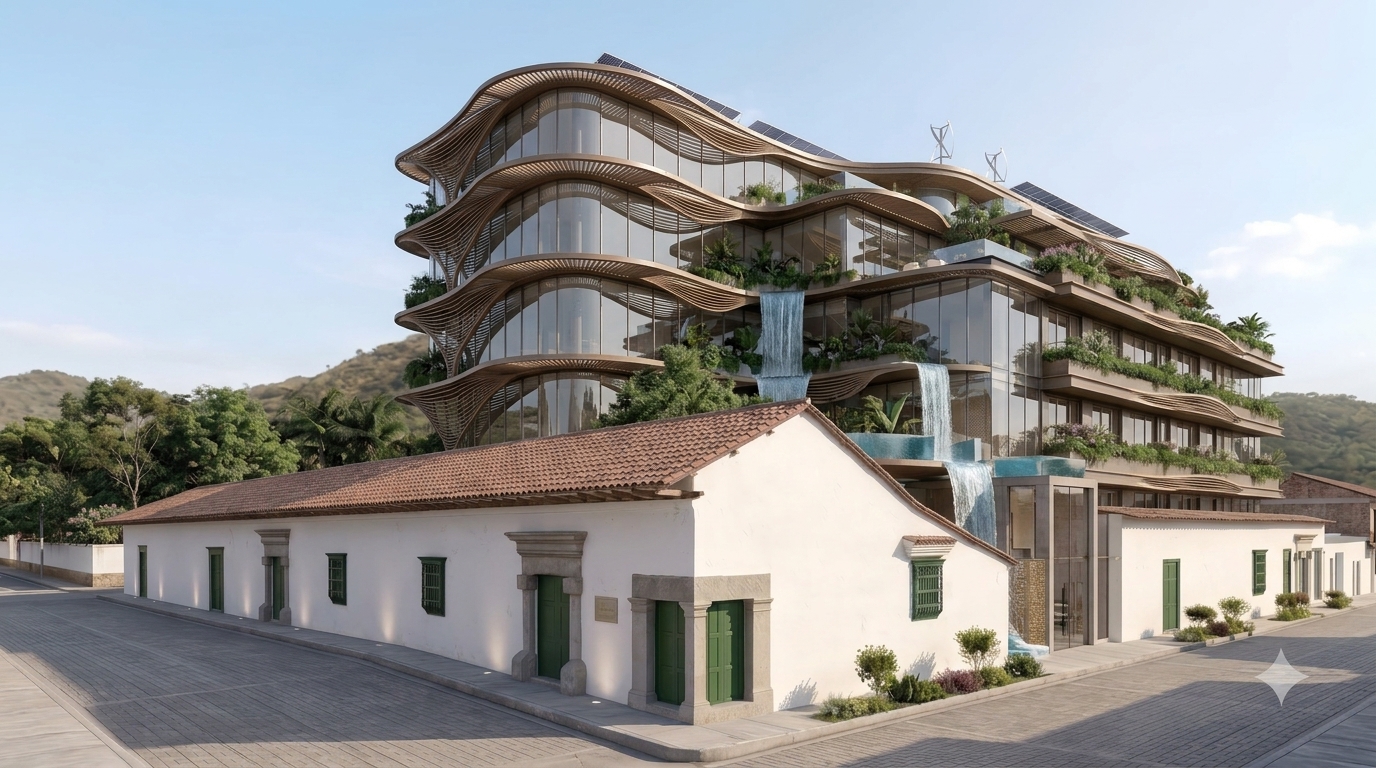
Schedule a visit to the property or contact the owner directly to learn more about this unique development opportunity.
8. White Papers: Empirical Evidence of Value Creation in Heritage Assets (Hospitality, Commercial & Mixed-Use)
Is there concrete economic evidence in Colombia proving that restoring architectural heritage and adapting it into luxury hospitality, prime retail, or contemporary mixed-use projects produces superior asset value and institutional returns? The answer is unequivocal: yes, robust domestic evidence exists. Its preeminent audited hospitality benchmark is the Sofitel Legend Santa Clara, and its leading commercial precedent is La Serrezuela.
In private real estate markets, transactions rarely disclose net internal rates of return (IRR) or private purchase deeds. We therefore classify empirical evidence by the degree of auditable documentation available (independent institutional appraisals, certified CAPEX budgets, and regulatory/industry records):
| Project | Evidentiary Chain | Verifiable Milestone | Evidentiary Weight |
|---|---|---|---|
| Sofitel Legend Santa Clara Cartagena • 1621 Convent |
Initial public auction; reported 3-year US$20M restoration; subsequent US$20M renovation; 2016 independent Jones Lang LaSalle (JLL) appraisal. | JLL appraised the property at US$ 48.407M net (~US$ 390,000 per key). Accor acquired 42% and later reached 62% corporate ownership based on this valuation. | Strong JLL Appraisal + Asset-level CAPEX |
| La Serrezuela Cartagena • National BIC Landmark |
Monumental restoration license Res. 5465/2016; 26,000 m² cultural, retail, and dining complex inaugurated in 2019. | Certified construction CAPEX exceeding COP $200,000M and reported commercial valuation by industry bodies (Mall & Retail) of COP $330,000M (100 stores, 1,900-person plaza). | Mid-Strong Retail scale + Disclosed capital investment |
| Four Seasons Casa Medina Bogotá • 1946 Architectural BIC |
Original purchase by Pedro Gómez (COP 70M) under conservation covenants; acquisition by Gilinski Group and Four Seasons partnership for full overhaul (Elemental D&C). | US$ 100M joint capital package for two hotels; opening nightly room rates from COP $990,000 to COP $7.3M; ultra-luxury market leadership. | Medium Validates brand positioning & capital influx |
| Casa Pestagua Cartagena • 18th-Century Casona |
Initial 2007 restoration (COP 1,400M by Barrera & Barrera) on 2,000 m² lot; second major institutional reinvestment in 2023. | Equity injection exceeding US$ 15M in 2023 and reopening under the prestigious Relais & Châteaux flag. | Medium Proves recurring private equity conviction |
| Four Seasons Hotel & Residences Cartagena • Getsemaní |
Restoration of historic cloisters and clubs integrated with new hospitality and residential master infrastructure by Valorem / San Francisco Investments. | Announced project investment exceeding US$ 300M; first phase of over 22,000 m² delivered. | Prospective Institutional scale during stabilization |
| Hacienda Santa Bárbara Bogotá • National BIC Hacienda |
Sale of remaining 90% of colonial estate land to develop a major contemporary commercial mall, inaugurated in 1989. | Over 35 years of uninterrupted retail operation with the historic casona serving as the core gateway and architectural focal point. | Longevity Demonstrates long-term commercial permanence |
| Charleston Santa Teresa & Casa San Agustín Cartagena • Cloisters & Casonas |
Pioneering historic conversions establishing luxury hospitality standards with concealed HVAC engineering and boutique suites over colonial walls. | Established leadership in RevPAR, ADR, and corporate retreat demand within the historic luxury sector. | Operational Validates sustained rate premiums |
Sofitel Legend Santa Clara (Cartagena)
The former 1621 convent of Santa Clara was acquired at public auction in the early 1990s by an investment syndicate led by Arias Serna Saravia. The original works represented a reported investment of US$ 20M (Folha de S.Paulo). Years later, the property executed a second major renovation for an additional US$ 20M (El Tiempo), delivering 124 rooms and signature master suites.
La Serrezuela Cultural & Commercial Center (Cartagena)
Former Circo Teatro declared a National Monument in 1995. Its monumental restoration permit (Res. 5465 of 2016) meticulously reconstructed the historic wooden bullring/theatre structure while integrating a contemporary complex of 26,000 m² containing 100 retail stores, an 800-seat gourmet dining hall, and a 1,900-capacity event arena (Argos, El Espectador).
Four Seasons Casa Medina (Bogotá)
Originally constructed in 1946 and declared architectural heritage in 1984. Acquired by developer Pedro Gómez (COP 70M under conservation commitments, Semana 1988). In 2015, the Gilinski Group and Four Seasons finalized a US$ 100M renovation and management partnership covering Casa Medina and Charleston Bogotá (El Tiempo, Semana; executed by Elemental D&C). Upon launch, it commanded nightly rates between COP $990,000 and COP $7.3M (Portafolio), proving that top global luxury brands aggressively prize authentic heritage character.
Casa Pestagua (Cartagena)
18th-century aristocratic manor (exact peer era of Casa del Virrey). Following its initial 2007 boutique restoration (COP 1,400M by Barrera & Barrera on a 2,000 m² parcel, El Tiempo), its owners executed a comprehensive 2023 reinvestment of over US$ 15M (La República) to relaunch under the prestigious Relais & Châteaux collection. This repeat capital commitment proves that private wealth consistently reinvests into scarce, irreplaceable colonial mansions.
Four Seasons Hotel & Residences (Cartagena)
Developed by Valorem and San Francisco Investments with reported capital exceeding US$ 300M (Portafolio). Restores historical cloisters integrated with over 22,000 m² of ultra-luxury hotel and branded residential inventory (Valorem).
Hacienda Santa Bárbara (Bogotá)
Colonial casona designated a National BIC (Mincultura). Inaugurated in 1989, the developer acquired the parcel to construct a major modern retail mall while retaining the historical casona as the heart and focal gateway of the entire complex (Official History, Semana 1990).
Charleston Santa Teresa & Casa San Agustín
The restored 17th-century Santa Teresa convent (Official History) and Casa San Agustín's 3-mansion compound demonstrate permanent RevPAR and ADR premiums, commanding year-round international luxury occupancy and elite destination events.
Why Global Hospitality Chains Actively Prioritize Historical Building Conversions
Major global hotel corporations predominantly operate under asset-light models rather than owning property (for example, 73% of IHG's rooms are franchised and 27% managed, with less than 1% company-owned or leased, per their official corporate filings). Consequently, 100% of the land appreciation, tax savings, and real estate value created belong exclusively to the property owner/developer, while the brand delivers distribution and premium pricing power:
IHG officially reported that conversions accounted for approximately 60% of their global openings and 40% of contract signings in 2025 (IHG Conversions 2025). Distinctive brands like Kimpton, Vignette Collection, and InterContinental (Kimpton Historic Hotels) actively target historic assets because they drastically reduce time-to-market and instantly unlock ADR premiums.
Marriott's Franchise Disclosure Document (FDD) for Autograph Collection explicitly promotes the adaptive reuse of historic or architecturally significant structures, allowing owners to preserve original property branding and identity (Marriott FDD). Landmark precedents like the US$ 120M restoration of the historic Illinois Building for InterContinental Indianapolis (IHG 2025) demonstrate the sheer scale of global capital dedicated to this asset class.
Business Thesis Applied to Casa del Virrey
A BIC designation does not generate value in isolation: the economic premium emerges when unreplicable historical character is paired with an economically viable contemporary master program.
At Casa del Virrey, the 18th-century casona serves as the "prestige anchor and brand house" (akin to Santa Clara, Casa Medina, and Hacienda Santa Bárbara), while the 5,700+ m² of free block land enables high-yield new commercial, hospitality, or residential construction (akin to La Serrezuela), fortified by a 100% corporate income tax deduction shield and 165% CoCrea tax credits.
9. Comparables & Target Value Logic
A close look at active listings across Mariquita, Honda, and Guaduas reveals a clear market structure:
- Standard products (family houses) sit mostly between $165M and $400M COP in Mariquita [Ciencuadras] [FincaRaíz].
- Central houses, quintas, and house-lots rise to ranges of $550M–$1,050M COP depending on size, location, and use [Metrocuadrado].
- Urban tourist houses and operating quintas reach values of $750M to $1.8B COP depending on program and finish [FincaRaíz Campestres].
- Restored colonial houses in the historic core position in ranges around ~$1,400M COP for properties clearly smaller than a full urban block [FincaRaíz].
Casa del Virrey occupies a different category entirely. It offers a full urban block with a corner BIC casona, sold at the pre-development stage: the buyer acquires land and brand identity, then invests in selective demolition, new architecture, and restoration. The target value logic flows naturally from the comparables: projects that fuse heritage with tourism, educational, healthcare, or mixed-use programming and execute with quality contemporary architecture have clear room to position in the premium tier of the regional market.
Project Economic Models for Casa del Virrey
Regulatory Framework & Development Viability: All project structuring on the urban block of Casa del Virrey (6,038 m²) must account for the special protection regime for Cultural Interest Assets (BIC) under Colombian Laws 397/1997 and 1185/2008, guidelines of the Special Management and Protection Plan (PEMP), the Mariquita (Tolima) POT, and licensing through local Urban Curatorship or Municipal Planning Authorities.
Residential & Community Project
- Residential masterplan with low-rise buildings, patios, and gardens, where the BIC casona serves as clubhouse, meeting hall, community space, and administrative seat.
- Revenue: sale of residential units, long-stay apartment rental, use of common spaces for private events.
Health, Wellness & Recovery Project
- Integral health center, rehabilitation clinic, or wellness campus, with new pavilions for consultations, therapies, accommodation, and body practice spaces, articulated around the BIC casona as reception and institutional image.
- Revenue: structured retreat programs, medical services, insurer agreements, alliances with public/private health institutions.
Educational & Cultural Project
- University or research campus, with classrooms, laboratories, residences, and library in new architecture, and the BIC casona as corporate governance seat and living museum of the site.
- Revenue: tuition, research agreements, cultural grants, contributions from public and private entities.
Hospitality & Experiences Project
- Boutique hotel + residences + cultural experiences, with the BIC casona as lobby, restaurant, bar, and event space, and new architecture housing rooms and tourist apartments.
- Revenue: hotel rates, event space rental, experience packages tied to the site's history and natural surroundings.
Commercial Project: Shops, Mall, Dining & Mixed Uses
- General retail shops: clothing, footwear, accessories, home décor, bookstore, pharmacy, electronics, beauty and personal care: everyday commerce for residents and visitors, with the added value of a unique heritage setting.
- Boutique shopping centre or retail gallery on block frontages, with fashion, crafts, design, and services, anchored by the BIC casona's heritage identity as the central cultural entrance of the complex.
- Gastronomic corridor with chef-driven restaurants, specialty cafés, bars, and terraces that turn the block into the culinary epicentre of Mariquita and the region.
- Gourmet market or modern market hall: local producer stalls, artisan food shops, and farm-to-table experiences capitalising on Tolima's agricultural wealth.
- Mixed-use commercial + creative hub: retail and regular shops on the ground floor, offices or coworking on upper floors, and the BIC casona as a gallery or event venue, generating diversified revenue from day one.
- Revenue: commercial lease income (shops, restaurants, cafés), percentage of sales, private and corporate event space rental, and brand sponsorships tied to the site's heritage appeal.
11. Investor Resource Directory
For buyers performing due diligence and market analysis, we provide the following directory of institutional and legal resources:
Mariquita Zoning (POT)
Municipal Master Urban Plan detailing permitted land use and density parameters.
Mariquita Planning Portal →ANI Colombia
Technical progress reports on the Cambao-Manizales 4G highway concession.
ANI Project Dossiers →SNR Colombia
Superintendency of Notaries and Registry for title verification.
Supernotariado Portal →12. Frequently Asked Questions (Economic & Development FAQ)
Direct answers grounded in Colombian statutory frameworks, urban planning decrees, and real estate market data for institutional investors and developers of Casa del Virrey.
Is the property currently operating as a hotel or sold as a development site?
It does not operate as an active hotel. Casa del Virrey is offered as a mixed-use heritage development site: a full 6,038 m² urban block with a corner BIC colonial casona (293 m²) and aged secondary outbuildings. The purchaser acquires the property to execute their own architectural master plan (boutique hotel, residential condominium, health & wellness retreat, or commercial gallery), selectively demolish non-catalogued structures, build contemporary architecture, and restore the historic casona utilizing public grants and statutory BIC tax shelters. Any commercial hostel operating elsewhere in Mariquita is an entirely separate, private business with absolutely no Cultural Interest Asset (BIC) heritage status.
Why is a full urban block more valuable than buying scattered lots?
A full urban block gives the developer complete perimeter sovereignty over all four street frontages, total control over vehicular and pedestrian access points, autonomous construction phasing, and eliminates condominium association disputes or easements with adjacent neighbors. Furthermore, anchoring the project around the iconic corner BIC colonial casona exponentially enhances perceived prestige, branding power, and target room rates or sale prices, a strategic commercial moat impossible to achieve on fragmented lots.
How do land and real estate prices in Mariquita compare to Honda, Guaduas, and other markets?
In Mariquita, standard residential units range between 165M and 400M COP, while central townhouses, estates (quintas), and land parcels trade between 550M and 1,050M COP, and boutique hospitality or colonial mansions command 750M to over 1,400M COP. In neighboring colonial tourist centers like Honda and Guaduas, comparable heritage properties trade at substantially higher square-meter benchmarks. With the delivered Tolima arterial section (146 km in full operation) and the completed 4G Cambao–Manizales trans-Andean corridor (256 km in total, with total capital investment exceeding COP $1,144,000 million —one million one hundred forty-four thousand million pesos, ~USD $275M—), Mariquita is cemented as the premier regional logistics, hospitality, and tourist junction with the fastest appreciation headroom in northern Tolima.
Can restoration works be co-financed through public grants and what amounts are available?
Yes. In Colombia, Level 2 (Architectural Conservation) properties qualify for public co-financing instruments: FONTUR (Law 2068 of 2020, Manual M-DMI-001) provides non-reimbursable co-financing of 30% to 100% depending on proponent category (up to 95% for Category 6 municipalities like Mariquita and 70% for departments) for tourism infrastructure; and Mariquita's Cultural Heritage Compensation Fund mechanism (PEMP Res. 0121/2025, Arts. 151–154) is designed to co-finance facades and roofs.
How does a foreign investor monetize the 165% CoCrea tax deduction without Colombian income?
By selling tradable Certificados de Inversión o Donación (CID) on the secondary securities market. Under Law 1834/2017, Law 1955/2019 (Art. 180), and Decree 697/2020 administered by CoCrea, BIC investments generate tradable CID securities. A foreign investor or pre-operational entity without domestic income can sell these CIDs to Colombian tax-paying corporations at a standard commercial discount (~10%-15%), converting the tax deduction into an estimated net cash inflow of 35% to 42% of the eligible invested budget.
What subsidized credit lines are available through FINDETER and IDB Invest?
FINDETER (Decree 4167/2011) offers rediscount loans with subsidized interest rates (200 to 300 basis points below DTF/IBR) with up to 15-year terms and 3 to 5-year grace periods for tourism infrastructure. Meanwhile, IDB Invest provides blended finance facilities combining long-term concessional debt with technical assistance grants for environmental accreditations (EDGE / LEED).
Can the property be built on, demolished, or modified given its heritage status?
The property features historic colonial structures (293 m²) and uncatalogued later additions on a 6,038 m² urban block. The colonial casona is governed by Level 2 conservation under Decree 1080 of 2015 (Art. 2.4.1.2.4) and the PEMP (Res. 0121/2025) (facade and volumetry preserved, full internal remodeling and structural modernization permitted). Secondary non-heritage structures can be selectively cleared and replaced with contemporary residential or hospitality buildings, following PEMP and PBOT (Acuerdo 019 of 2004) guidelines.
Does the BIC heritage status prevent or burden development?
No. On the contrary, the BIC regime optimizes project economic viability along two complementary tracks: first, through concrete statutory financial and tax incentives (100% income tax deductions amortizable over 5 tax years, 165% CoCrea CID secondary market cash liquidity, non-reimbursable facade/roof grants, and retaining 70% of urban plusvalía across over 5,000 m² of new buildable land); and second, by providing an irreplaceable 18th-century brand anchor. While foreign benchmark studies (CBRE / PKF Hospitality and Boston University (BHR)) document +18% to +50% ADR premiums for heritage landmark hotels over standard luxury assets, the immediate advantage in Colombia is delivering an exclusive hospitality, high-end events, and cultural tourism destination with a competitive moat impossible to replicate on any generic suburban lot.
What impact do BIC fiscal benefits have on project cash flow?
Income tax deductions for PEMP formulation and heritage conservation (Law 397/1997 and Law 1185/2008 Art. 14), paired with CoCrea 165% CID secondary monetization and FONTUR grants, drastically minimize equity exposure. In our modeled scenario for Casa del Virrey, an illustrative $1.8B COP restoration CAPEX generates ~$864M COP in cash rebates and public subsidies, delivering an effective 48% net cost savings on the historic mansion.
Are the tax benefits and subsidies legally guaranteed?
Tax benefits and co-financing instruments are statutory rights enacted by national laws (Law 1185/2008, Law 1834/2017, Law 2068/2020) and administrative decrees (PEMP Res. 0121/2025). Concrete receipt requires the developer to submit the technical intervention project and secure the corresponding regulatory approvals.
Where can I review the complete statutory and regulatory framework?
All regulations governing Cultural Interest Assets (BIC), Level 2 architectural interventions, PEMP formulation, permitted uses, income tax deductibility, and statutory decrees are detailed with official citations in our specialized technical guide:
Historic Conservation Regulation in Colombia (BIC Regulation) — casadelvirrey.co
Official Sources & Institutional Reports
- PEMP San Sebastián de Mariquita (Resolution 0121 of 2025): Special Management and Protection Plan for the Historic Center approved by the Ministry of Cultures, Arts and Knowledge: Resolution 0121 of 2025 (Official Mariquita Municipal PDF).
- PBOT San Sebastián de Mariquita (Municipal Agreement 019 of 2004): Basic Territorial Land-Use Plan of San Sebastián de Mariquita (Municipal Council): Agreement 019 of 2004 (Official Mariquita Municipal PDF).
- Technical Urban Diagnostic PBOT Mariquita: Technical Support Document for Urban Land Planning (Comprehensive 414-page study): PBOT Mariquita - Agreement 019 of 2004 (Official PDF).
- CBRE / PKF Hospitality Research: Historic Hotels: Revenue Premiums Offset Greater Costs (Empirical comparative study of ADR and RevPAR premiums in historic hotels): HospitalityNet | CBRE Research Report.
- Boston Hospitality Review (Boston University): The Pricing Effects of Heritage at an Iconic Hotel (Empirical pricing power and willingness-to-pay for heritage hotel assets): Boston University BHR Research.
- CoCrea / MinCultura: Corporación Colombia Crea Talento — Official Platform for Cultural Heritage Projects and CID Tax Credit Securities: Official CoCrea Colombia Portal: CID Tax Incentive.
- FONTUR (National Tourism Fund): Grant co-financing programs for tourism infrastructure and heritage competitiveness: Official FONTUR Colombia Portal: Project Manual.
- FINDETER (Territorial Development Bank): Rediscount Credit Facilities and Subsidized Interest Rates for Sustainable Tourism (Decree 4167 of 2011): Official FINDETER Portal.
- IDB Invest (Inter-American Development Bank Group): Blended finance and concessional loan solutions for sustainable private hospitality projects: Official IDB Invest Portal.
- National Infrastructure Agency (ANI): Cambao - Manizales 4G Highway Concession Project Dossier (COP $1,144,000 Million / ~US$ 275M at official TRM Sep 2024): ANI Colombia | Cambao Manizales.
- Ministry of Transport of Colombia: Northern Tolima Highway Infrastructure Progress Report (146 km): MinTransporte Colombia.
- DANE (National Administrative Department of Statistics): New Housing Price Index (IPVN) & ICOCED Building Construction Indicators: DANE Construction & Real Estate.
- Camacol (Colombian Construction Chamber): Economic Studies & Urban Coordinates Report for Tolima: Camacol Colombia.
- Consolidated Real Estate Portals (Metrocuadrado, Properati, Mitula, Ciencuadras, FincaRaíz): Square Meter Price Analysis and Listing Sample in San Sebastián de Mariquita (2026): Metrocuadrado Mariquita · Ciencuadras Mariquita · FincaRaíz Mariquita · Properati.
- Tinsa Research: Real estate market studies and valuation reports for Colombia: Tinsa Colombia | Research.
- Law 397 of 1997 (Cultural Heritage): Income tax deductions for owners of Cultural Interest Assets (BIC): Law 397 of 1997 (PDF).
- Law 1185 of 2008 (Cultural Heritage Reform): PEMP requirements and heritage conservation incentives: Law 1185 of 2008.
- Law 388 of 1997 (Territorial Planning): Compensation instruments for properties under historic conservation treatment: Law 388 of 1997.
- Law 1834 of 2017 & Law 1955 of 2019, Art. 180 (Creative Economy & National Development Plan): 165% income tax deduction and issuance of tradable Certificados de Inversión o Donación (CID) administered by CoCrea: Law 1955 of 2019 (Art. 180).
- Law 2068 of 2020 (General Tourism Law): Non-reimbursable co-financing of 30% to 100% for tourism infrastructure according to proponent category and up to 100% in pre-investment via FONTUR: Manual FONTUR M-DMI-001 (PDF).
- National Tax Statute (Art. 512-2): Statutory allocation of 30% of the National Consumption Tax on mobile voice and data services for cultural heritage: Tax Statute Art. 512-2.
- Gobernación del Tolima: Tourism and general information for the municipality of Mariquita: Tolima Government | Mariquita.